
Table of Contents
ToggleDigital Marketing in 2026: How AI Agents Are Replacing Traditional Campaign Managers
Introduction: What Changed When No One Was Paying Attention
I’ve spent enough years in digital marketing to remember when “campaign management” was a very hands-on job. You opened spreadsheets first thing in the morning. You checked numbers more often than you checked messages. Weekly calls weren’t about growth or direction; they were about explaining why something didn’t work the way it was supposed to.
Back then, performance lived or died on reaction time. If you noticed a problem early, you could save budget. If you noticed it late, the damage was already done and everyone just tried to explain it. that version of marketing didn’t vanish overnight. It slowly became outdated.
By the time we reached digital marketing in 2026, something had quietly shifted. Tools stopped waiting for people. Budgets adjusted themselves. Ads paused automatically. Decisions were being made long before reports were opened. Not because marketers stopped caring, but because systems became faster than humans could reasonably be.
That’s when AI marketing agents stopped being “helpful tools” and started acting like operators.
At Digivertix, Digital Marketing Agency this didn’t happen in theory or slide decks. It happened account by account. Campaigns that leaned into AI execution didn’t just feel easier to manage — they performed better. Less waste. Fewer emergencies. More consistency. This article isn’t meant to sell fear or hype. It’s meant to explain what’s actually happening, from the inside.
1.What AI Marketing Agents Really Do
AI marketing agents aren’t mysterious, and they aren’t magic. They’re also not robots thinking like people. They’re systems built to observe behavior and react faster than a human ever could.
In real campaigns, AI marketing agents constantly watch how users interact with ads, websites, emails, and content. They track small changes most people wouldn’t notice right away — a dip in engagement, a shift in intent, a pattern forming across devices or times of day. When those signals change, the system reacts immediately.
That reaction might look simple. A budget moves. A bid increases slightly. One message gets tested more than another. But those actions happen continuously, not once a day or once a week.
At Digivertix, these systems make thousands of micro-decisions daily. No human team could do that without burning out or missing things. Individually, those decisions don’t feel dramatic. Over time, they add up to something very noticeable: smoother performance and fewer surprises.
This is why AI-driven campaigns often feel calmer. There’s less panic, less fixing things after they break, and more steady progress without constant intervention.
2.Why AI Became Necessary in Digital Marketing
AI didn’t take over digital marketing because it was trendy. It became necessary because marketing itself changed.Platforms update constantly. Algorithms shift without warning. Audiences behave differently depending on context, timing, and device. What worked last week might quietly stop working today, and there’s no announcement when it happens.
Humans are still good at strategy and creativity, but we aren’t built for nonstop, real-time execution across multiple platforms. That gap kept growing until something had to fill it.
AI Marketing tools in digital marketing stepped into that gap. AI doesn’t hesitate. It doesn’t guess. It doesn’t wait for someone to approve a change. It responds as data changes. That responsiveness is what modern marketing requires.
Brands working with Digivertix often notice something interesting once AI systems are properly implemented: performance becomes more stable. Not necessarily explosive overnight growth, but fewer sudden drops and fewer expensive mistakes. In a crowded market, that stability creates long-term advantage
3.AI Marketing Agents vs Human Campaign Managers
The conversation around AI marketing agents who use AI Marketing Tools versus human campaign managers often turns into an argument about replacement, but that framing is misleading. What actually changed wasn’t the value of humans, but the value of time. Traditional campaign managers were never ineffective; they were simply limited by how fast they could see, think, and act. When campaigns were smaller and platforms were predictable, that limitation didn’t matter much. By 2026, it matters a lot.
Human campaign managers still bring context, judgment, and creativity. They understand brand voice, customer trust, and long-term reputation. What they struggle with now is volume and speed. Modern campaigns generate more signals in a single hour than teams used to review in a week. By the time a person opens a dashboard, the moment that mattered may already be gone.
AI marketing agents don’t think the way humans do, and that’s exactly why they fit this new environment. They don’t hesitate, debate, or wait for alignment. They respond. When costs rise, they adjust. When intent shifts, they follow it. There’s no emotional attachment to a creative, no bias toward what “should” work. There’s only what is happening right now.
At Digivertix, this shift didn’t remove campaign managers from the process. It changed what they spend their energy on. Instead of reacting to problems, they define direction. Instead of fixing small issues, they focus on strategy and messaging. AI handles execution; humans handle meaning. The campaigns that perform best aren’t run by AI alone or humans alone, but by a quiet collaboration between the two
4.Types of AI Agents Used in Modern Marketing
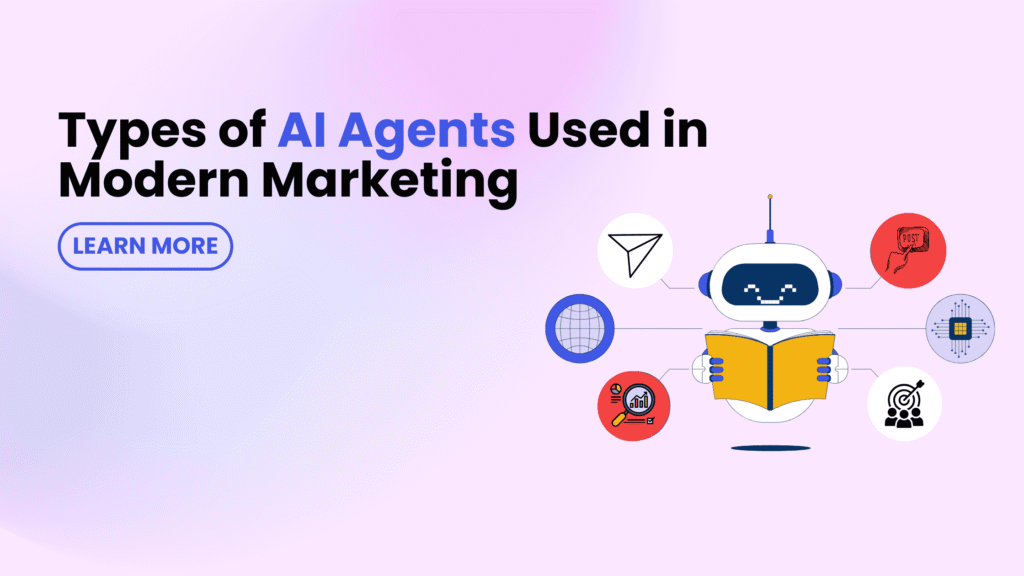
Most people imagine AI in marketing as one large system doing everything. In reality, it’s much messier and much more practical than that. Modern marketing relies on multiple AI Marketing Tools , agents, each doing a very specific job, often without anyone noticing. That’s part of why the transition feels subtle rather than disruptive.
Some agents spend their time watching behavior patterns. They notice how people move through pages, where attention drops, and which signals tend to lead to conversion. Others focus almost entirely on bidding and pacing, adjusting budgets in response to auction dynamics that change minute by minute. There are also agents constantly testing variations of creative, not because they understand design, but because they can measure response without opinion.
What makes this system effective isn’t any single agent. It’s how they quietly share context. A shift in audience behavior influences bidding. A change in creative performance affects budget flow. Decisions are connected, even if no human explicitly connects them.
At Digivertix, this layered approach is what separates AI-assisted marketing from true autonomous marketing systems. When these agents work together properly, campaigns feel smoother to users. Nothing looks forced or overly optimized. Behind the scenes, decisions are happening constantly, but to the audience, the experience feels natural. That invisibility is often the clearest sign the system is working.
5.How AI Enables Predictive Campaign Optimization
One of the biggest advantages AI brings to digital marketing isn’t automation — it’s anticipation. Humans are excellent at explaining what already happened. AI is better at noticing what usually happens next. That difference sounds small, but in practice, it changes everything.
Predictive campaign optimization isn’t about forecasting the future with certainty. It’s about recognizing patterns early enough to act before performance visibly changes. AI looks at historical behavior and compares it with what’s happening right now. When something starts to drift — engagement slowing, costs creeping up, conversions taking longer — the system notices before the numbers become alarming.This is where humans often struggle. A campaign might look “fine” on the surface while slowly becoming inefficient underneath. By the time a person identifies the issue, the opportunity to correct it cheaply is gone. AI doesn’t wait for clarity. It responds to probability.
At Digivertix, predictive optimization often works quietly. Budgets are adjusted before waste becomes obvious. Creative is rotated before fatigue shows up in reports.This is why AI-driven campaigns tend to feel steadier over time. They don’t spike as wildly, and they don’t crash as often. The system isn’t chasing perfection; it’s avoiding preventable loss. And in a fast-moving digital environment, that restraint is often what separates consistent growth from constant recovery.
6.Real-Time Campaign Monitoring Using AI Agents
Campaign monitoring used to be one of the most difficut parts of AI in digital marketing. There was always the feeling that some part is might be going wrong somehow, and the only way to keep checking. Dashboards were refreshed constantly. Notifications were watched closely. Even then, problems were usually discovered after they had already started costing money.
Real-time monitoring changed completely once AI agents became part of execution.What makes this different from traditional monitoring is not visibility, but response. AI doesn’t just notice a change; it reacts immediately. If something begins to drift, even slightly, adjustments happen without waiting for confirmation. Humans no longer need to be “on alert” all day. They step in only when something requires judgment rather than reaction.
At Digivertix, this shift has changed how teams experience their work. Campaigns don’t feel fragile anymore. There’s less fear of missing something important. Instead of reacting to issues, marketers review outcomes and think ahead. Monitoring becomes background noise, not a constant source of pressure.
7.Skills Marketers Must Learn to Survive AI Disruption
AI didn’t make marketing easier. It made it different. The skills that once defined a good campaign manager are no longer enough on their own. Being fast with spreadsheets or comfortable inside ad platforms still matters, but it no longer creates an advantage.
The marketers who struggle most with AI disruption are usually the ones who try to compete with it. They attempt to out-optimize machines or insist on manual control where speed matters more than precision. That approach rarely works for long.
The marketers who adapt tend to develop a different set of strengths. They focus on interpretation rather than execution. They ask better questions instead of chasing perfect answers. They understand what AI outputs mean in context, not just what the numbers say. Most importantly, they know when automation should stop.
At Digivertix, the strongest marketers are not the ones who trust AI blindly, nor the ones who resist it. They guide it. They set boundaries. They protect brand voice, customer trust, and long-term reputation. AI handles speed and scale, but humans remain responsible for direction and accountability. That responsibility hasn’t disappeared. If anything, it has become more important.
8.How Businesses Can Start Using AI Marketing Agents
One of the huge mistakes businesses make with AI is trying to move very fast. Fully automations sounds like appealing, but jumping directly into it often creates confusion rather than improvement. AI amplifies whatever system already exists. If the foundation is unclear, automation only spreads the problem faster.
The businesses that adopt AI successfully tend to move gradually. They start by letting AI observe rather than control. Reporting and analysis are automated first. Patterns become visible. Confidence builds slowly. Only then does execution begin to shift.
At Digivertix, adoption usually happens in phases, even if it doesn’t look formal from the outside. everyone learn to trust AI with every small decisions before handing over to other responsibility. Humans remain involved, but their role changes from doing everything to supervising intelligently.
This approach reduces risk and builds understanding. AI becomes part of the workflow rather than something separate or intimidating. Over time, the question stops being “Should we use AI?” and becomes “Where does human judgment add the most value?” That’s the point where adoption feels natural instead of forced..
9.Risks and Ethical Concerns of AI Marketing
AI moves quickly, but it doesn’t understand consequences. That’s where risk lives.Systems learn from data, and data always carries bias, gaps, and assumptions. Left all alone, AI will optimize everything it’s order to optimize, even if the result feels not corrected to a human on the other side of the screen.
Privacy is one more concern, but it’s not the only one. Overexposure. Message fatigue. Subtle erosion of trust. These don’t show up immediately in metrics, but they matter.
At Digivertix, ethical oversight isn’t treated as compliance theater. It’s treated as protection. AI systems are questioned. Sometimes limited. Sometimes overridden. Not because they’re failing towards them, but because their speed without providing proper judgment creates problems sometimes that don’t show up until it’s too late.AI doesn’t make moral decisions. Humans still do. And pretending otherwise is where most long-term damage begins.
10.The Future of Digital Marketing in 2026 and Beyond
The future of digital marketing isn’t fully automated, and it isn’t human-only either. It sits somewhere in between. AI handles speed, scale, and pattern recognition. Humans is trying to handle everything like from meaning to direction till consequence.
By 2026, the brands that perform best are not ones that are using the most advanced tools, but the ones using them with sharp mind. They understand what AI is good at and what it isn’t. They allow machines to react quickly, but they don’t give up control over purpose. At Digivertix, the future doesn’t look like marketers disappearing.
It looks like marketers spending less time fixing small problems and more time shaping direction. Campaigns become less chaotic. Decisions become quieter. Growth becomes steadier. The real change isn’t technological. It’s cultural. Marketing moves from constant reaction to intentional guidance. And once that shift happens, there’s no real desire to go back.
Conclusion: Why this type of Shift Can’t Be Ignored
Digital marketing in 2026 rewards brands that adapt early. AI marketing agents are replacing traditional campaign managers because they remove delay and waste, not because people failed.
With the right guidance, like that provided by Digivertix, AI becomes an advantage — not a threat.
Frequently Asked Questions
Digital marketing in 2026 doesn’t feel dramatic. It feels quieter. Less chasing numbers, fewer late fixes. AI in digital marketing runs things in the background while humans focus on direction. You notice fewer emergencies, not because marketing is perfect, but because problems get handled before they grow.
AI marketing agents in 2026 didn’t become popular because they were exciting. They became necessary because marketing got too fast. Platforms change daily. Audiences shift suddenly. Humans couldn’t keep reacting in time. AI stepped in where delay was quietly wasting money. exercitation.
No, it doesn’t feel like older automation. AI in digital marketing reacts instead of following rules. It adjusts when behavior changes, not when someone clicks “update.” That difference matters more than people admit, especially now when campaigns can change direction within hours.
Yes, but their role changed. In digital marketing in 2026, managers don’t spend all day adjusting settings. AI handles that. Humans decide what the brand should stand for, what feels right, and when automation should slow down or stop completely.
AI marketing tools help by removing constant checking. They watch performance quietly and react early. You don’t feel them working. You just notice fewer surprises. Over time, that calm becomes more valuable than flashy growth spikes that don’t last.
Yes, absolutely. AI marketing agents in 2026 don’t understand context or tone. They only see patterns. That’s why humans still matter. Someone has to notice when performance looks fine but feels wrong for the brand or audience long term.
It can be, if used carefully. Small businesses benefit most when AI in digital marketing handles monitoring first, not control. Letting systems observe before acting builds trust. Jumping straight into full automation usually creates confusion instead of growth.
The future of digital marketing doesn’t look louder or more complex. It looks steadier. AI handles speed. Humans handle meaning. Brands that balance both stop reacting all the time and start growing in a way that feels controlled, not chaotic.